Sheet R-302In progress
Axial Systems in Ancient Near Eastern Architecture
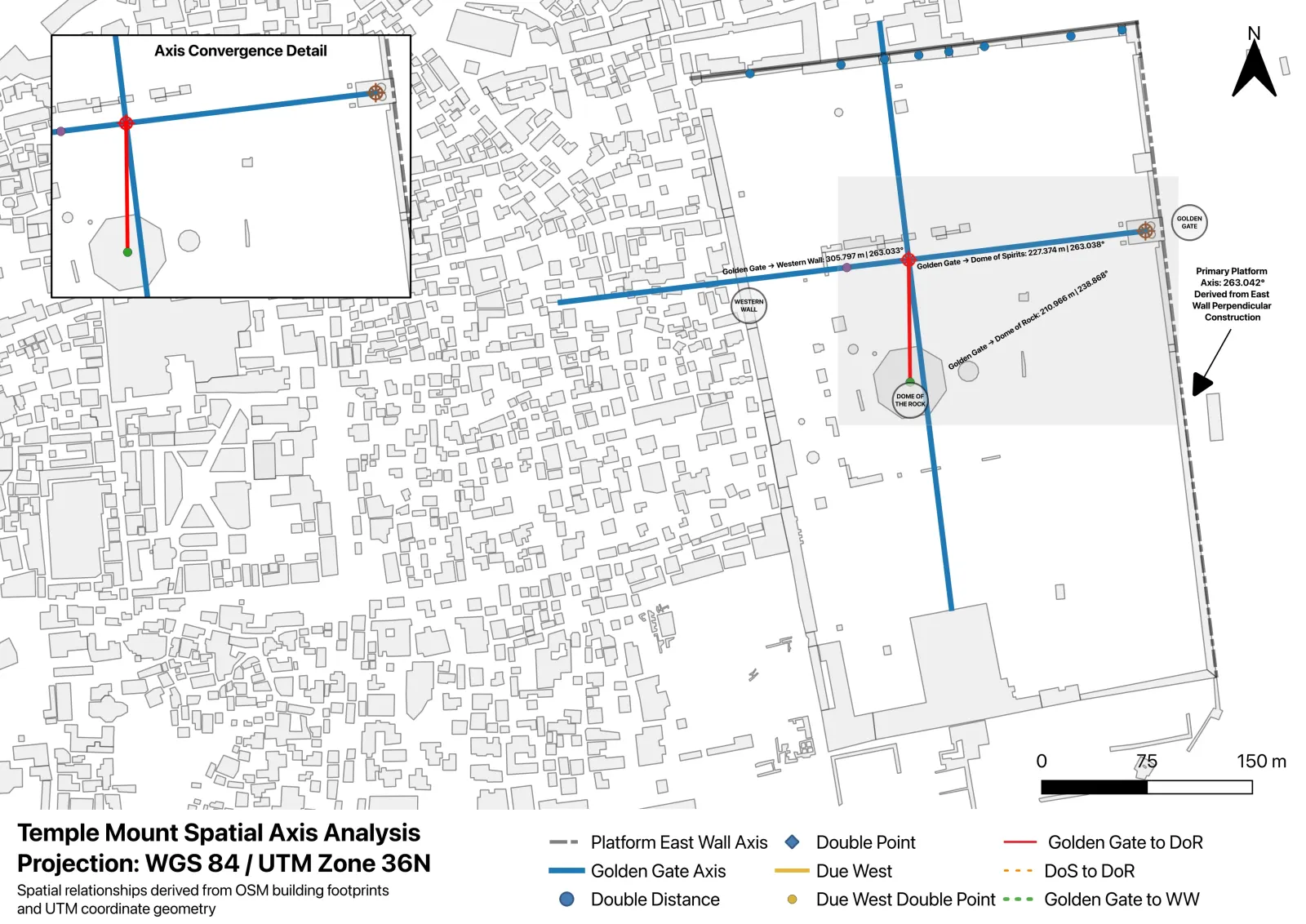
This ongoing body of research investigates the mathematical, topological, and cosmological logic underlying the spatial organization of Ancient Near Eastern precinct architecture. Building upon earlier work in probabilistic spatial modeling and sacred precinct reconstruction, the study explores whether persistent axial relationships can be computationally identified across historically layered architectural sites.
Computational Aim
Using GIS-based analysis, Monte Carlo simulation, geometric constraint testing, and computational archaeology workflows, the project seeks to identify recurring organizational systems embedded within temple precincts, civic compounds, and ceremonial landscapes throughout the Ancient Near East.
Architecture as Spatial System
Rather than approaching historical architecture solely through textual interpretation or stylistic reconstruction, the research treats architecture as a measurable spatial system shaped by procession, hierarchy, visibility, orientation, environmental logic, and ritual order.
Spatial Persistence
Particular attention is given to how axial geometries persist through periods of reconstruction, expansion, political transition, and stratigraphic change, allowing later architectural phases to be studied as transformations of earlier spatial orders rather than isolated formal episodes.
Method Framework
The framework combines probabilistic spatial analysis, topological persistence studies, centroid and alignment testing, computational reconstruction methods, and architectural design translation.
Comparative Scope
Current investigations include comparative analysis between Levantine, Israelite, Mesopotamian, and broader regional precinct systems to evaluate whether measurable spatial signatures emerge across differing cultural and temporal contexts.
Current Status
Research framework and comparative methodology development are currently in progress. Initial computational models and probabilistic spatial studies were completed through prior thesis research, with ongoing expansion into cross-site comparative analysis and generalized axial-system detection methodologies.
The long-term objective is a reproducible computational methodology for evaluating ancient architectural order under uncertainty, bridging archaeology, architecture, data science, and historical spatial analysis.