SHEET SERIES R-300
Research
Spatial research that makes interpretation visible, testable, and repeatable — GIS, simulation, and null-model comparison applied to architectural questions.
R-301 · Featured
- M.Arch thesis
- First-place graduate thesis prize
- In preparation for peer review
Probabilistic Spatial Constraint Modeling for Sacred Site Reconstruction
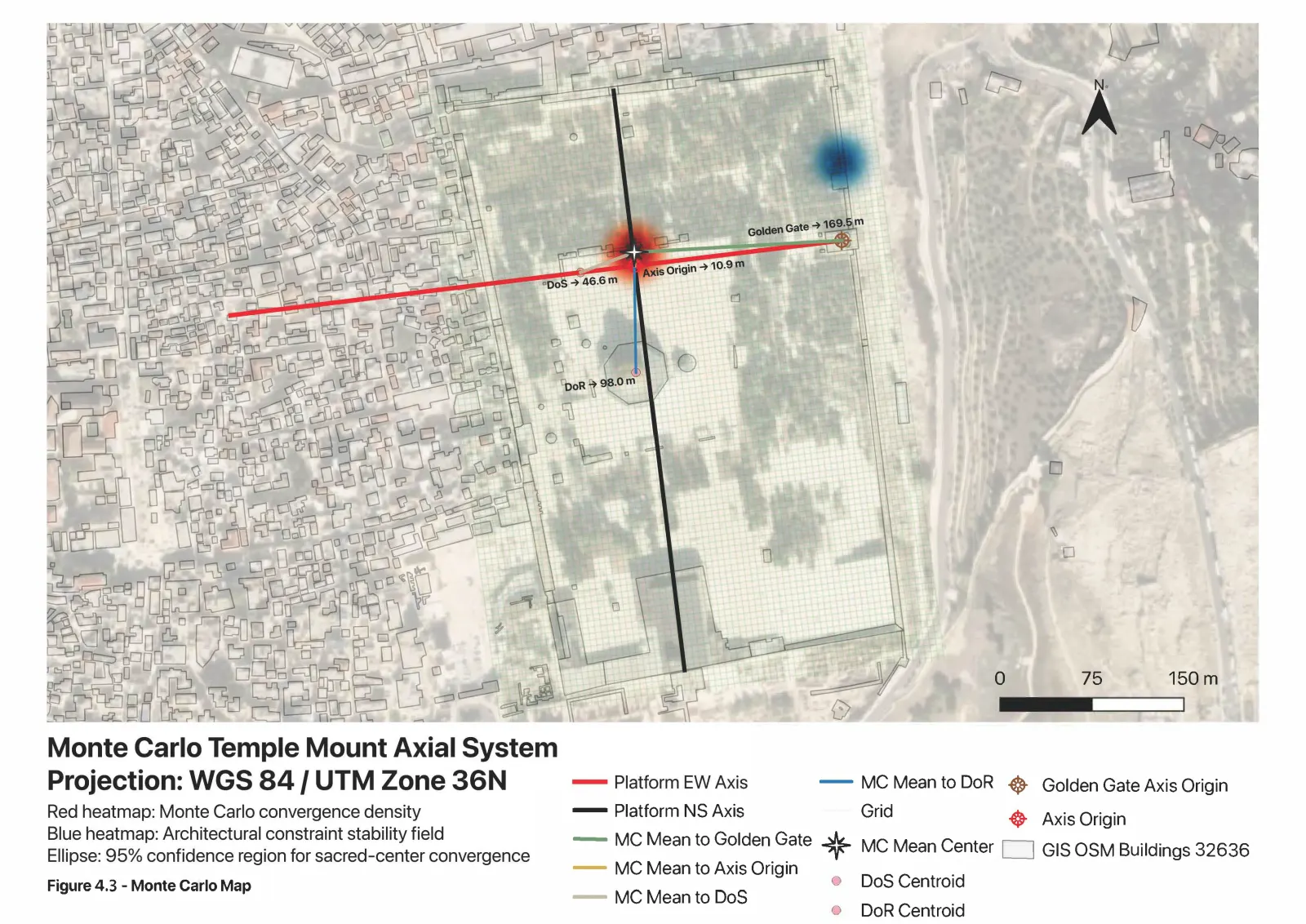
The research translated textual, historical, archaeological, and architectural evidence into a testable geospatial framework. The goal was not to prove a final historical location, but to determine whether measurable spatial relationships on the existing platform produced a statistically meaningful convergence pattern when tested against uncertainty.
Probabilistic Spatial Constraint Modeling makes interpretation visible, testable, and repeatable — design decisions emerge from quantified spatial evidence rather than narrative certainty.
Five-stage workflow
- 01PrepareClean and normalize layers into one controlled GeoPackage in EPSG:32636.
- 02ObserveBuild axial and centroid relationships from measured geometry.
- 03PerturbMonte Carlo uncertainty modeling within measured tolerances.
- 04CompareTest the observed model against randomized null orientations.
- 05StressLeave-one-out sensitivity: remove each constraint and re-test.
Schedule — R-300.1
Studies, fieldwork, teaching
R-302 · Study · 2026–In progress
Axial Systems in Ancient Near Eastern Architecture
Ongoing research into whether persistent axial relationships can be computationally identified across historically layered Ancient Near Eastern precincts.
R-303 · Fieldwork · 2025Complete
Fieldwork: Tel Hanaton & Tel Azekah
Archaeological field school — site layout, excavation, stratigraphic recording, and spatial documentation in Israel.
Archaeological Field School — Tel Hanaton & Tel Azekah, Israel
R-304 · Teaching · 2026–Ongoing
Teaching — Architecture History & Theory
Adjunct Professor of Architecture History and Theory at the University of the District of Columbia.
University of the District of Columbia
Schedule — R-300.2
Publications
- 2026First-place graduate thesis prize
Restoring the Jewish Temple: A Spatial Study
M.Arch thesis, University of the District of Columbia
- 2026In preparation for peer review